
Community Conversations
About Renate:
Renate Larssen is an equine ethologist and anthrozoologist. She has a multi-disciplinary research background focusing on animal experiences and animal-human relationships from the perspectives of the animals. She recently submitted her PhD thesis which explores the lived experiences of sheep, horses and dogs in later Iron Age Scandinavia (c. 400-1100 CE) through the lens of 'archaeoethology', a novel theoretical framework she developed by combining ethology with archaeological theory and methods. Renate also has extensive practical experience working internationally as an equine behaviour consultant and lecturer.
If you want to learn more from Renate, I highly recommend her Substack: https://theequineethologist.substack.com/
Here are some take home points from this conversation for you to reflect on:
1) On the horse-human bond:
The "innate, magical" bond (à la Black Stallion) many of us grow up idealising often doesn't survive contact with reality. This is highlighted through the use of control tools like bits, whips, and spurs that suggest a relationship built more around compliance than genuine connection.
“Real” connection tends to show up in the moments with no reinforcement at all - it happens in the mundane, fleeting moments outside of training where there has been no plan or desired outcome.
2) Horses and humans have divergent goals:
A lot of horse-human conflict comes down to mismatched motivations rather than disobedience, e.g. many horses find working in the arena to be boring because it acts in opposition to their innate desire to explore their home ranges.
Riders often mistake structured, repetitive training as inherently good for the horse because of societal conditioning, when it may hold no meaning for the horse at all.
3) On reinforcement and cognition
Horses trained primarily with negative reinforcement/pressure-release are argued to become less capable problem-solvers - some may perceive this as a lack of intelligence, however it’s more likely that they're rarely given the chance to practice agency, curiosity, or decision-making.
This creates a research confound too: studying "domesticated horse cognition" may really be studying artificially suppressed cognition, since most study subjects have never been allowed to develop those skills.
Positive-reinforcement approaches (and more broadly, an attitude of allowing choice and exploration) were linked to horses being calmer, more curious, and more resilient when problems arise - thus appearing more intelligent.
4) The importance of social development is often overlooked:
Social development is not innate - it is learned.
Early weaning and isolation from mixed-age herds may deprive young horses of the chance to learn healthy social behaviour from adults, this could be comparable to the human equivalent of raising children with no adult guidance ("Lord of the Flies").
5) A little bit about Renate’s fascinating PhD thesis:
She's developed a framework applying modern ethology (via an adapted Five Domains model) to archaeological animal remains, to reconstruct the lived experience of animals in the past primarily from their bones.
She draws on Saidiya Hartman's concept of "critical fabulation" - a way of respectfully reconstructing the stories of subjects whose only historical trace comes through records of violence or ownership, without overstating what can actually be known.
6) Professional practice and ethics
There is an emotional weight of being the "translator" between horse and owner - seeing what the horse needs while managing client expectations and industry norms is often exhausting.
There is a normalised "anti-precautionary" pattern in equestrian culture - referencing philosopher Jonathan Birch: harmful practices become accepted as the baseline, and improvement is measured as tweaks to that baseline rather than questioning whether the baseline itself is ethical.
7) Final thoughts
Perfect welfare isn't possible - welfare is asymptotic, not absolute.
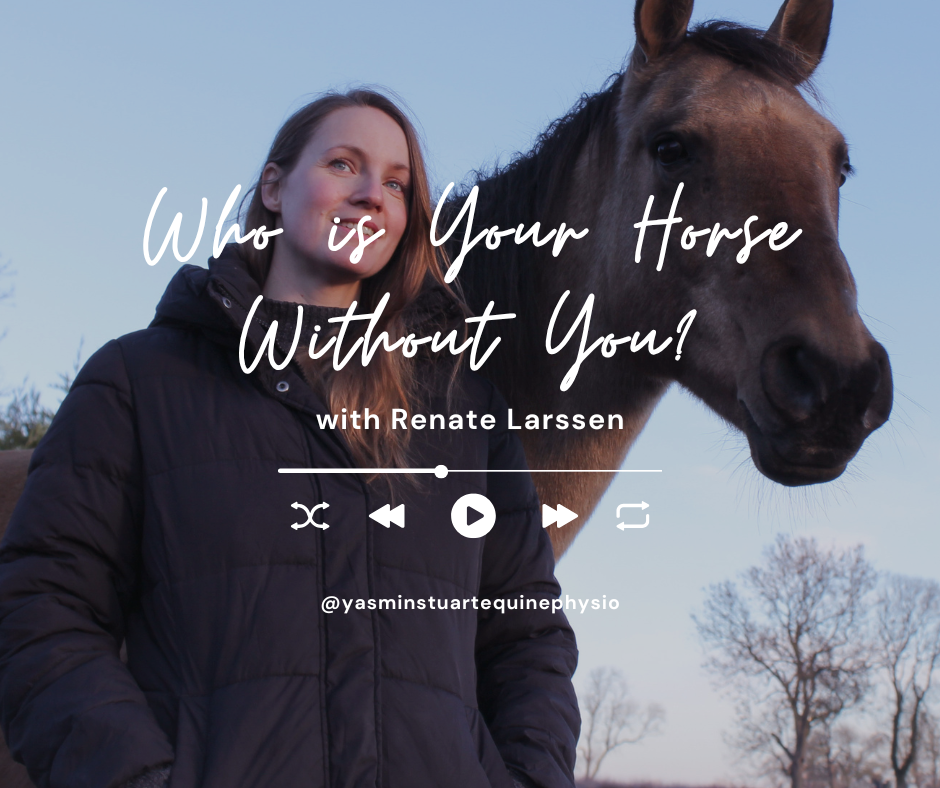
Get curious about who your horse is without you - what they'd choose to do given the option - and build in more choice wherever possible, since choice itself is part of what makes an experience enjoyable (not just the activity itself).