
Community Conversations
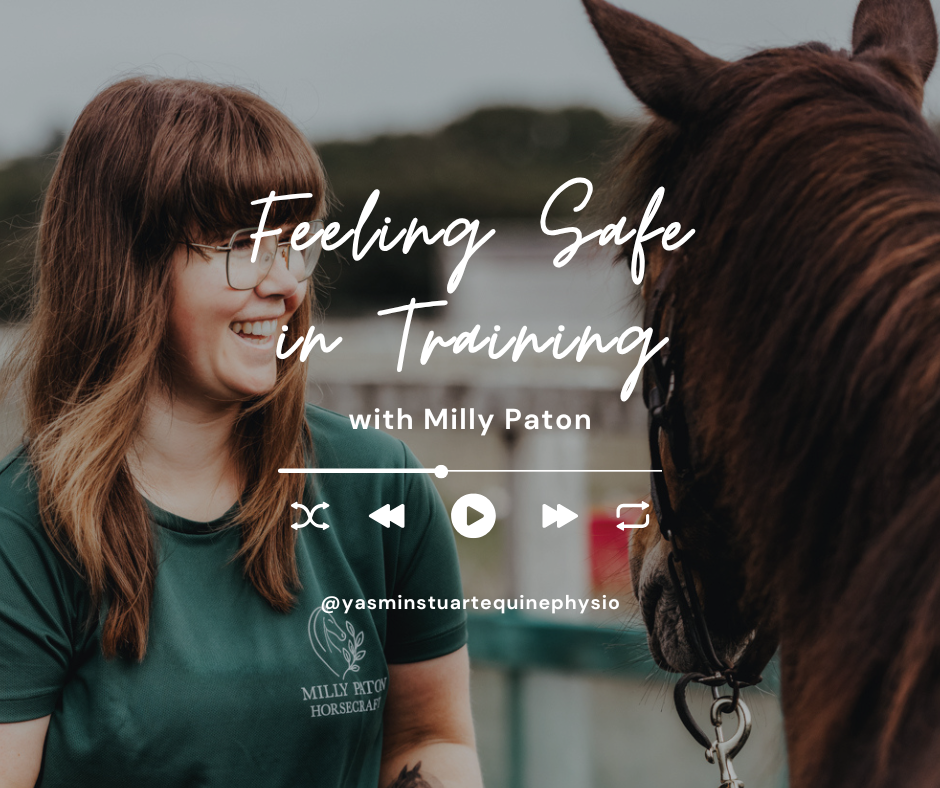
About Milly:
Milly is the founder of Milly Paton Horsecraft. She is passionate about helping horses and their owners thrive in their partnership by finding a shared sense of safety, trust and joy.
Milly utilises a holistic, force-free approach that is underpinned by science. She is a qualified positive reinforcement trainer and trauma informed trainer, an Equine Sports Massage Therapist and is also a current student on the Equine Science MSc program at The Royal (Dick) School of Veterinary Studies.
In addition to this, Milly is a mental health nurse with 20 years experience in the sector, and brings these two unique and diverse skill sets together to help both horse and human find emotional regulation together.
Milly has been surrounded by horses her whole life as a life-long resident of the New Forest, and loves nothing more than getting out with her dog watching the semi-feral ponies in their natural habitat.
Here are some take-home points from this conversation for you to reflect on:
1) People show up with horses the same way they show up elsewhere
How someone communicates, manages emotion, and relates to others often transfers directly into how they relate to their horse (and vice-versa).
Many “horse problems” are actually “human nervous system + communication” problems, not purely training problems.
2) Emotional regulation is not having “no feelings”
Regulated does not equal calm/neutral or emotionless.
Dysregulated is not simply “negative feelings.”
The distinction is more about processing emotions and responding with capacity (feeling able to deal with what’s there), rather than being controlled by unprocessed emotion.
3) Why regulation matters in training
Horses need humans to be safe and predictable in the moment.
When the human can stay present and coherent (even while having feelings), the horse is more able to drift toward homeostasis.
It’s about managing-in-the-moment and processing-afterwards, rather than suppressing feelings.
4) Dysregulation is normal - and context dependent
No one is regulated all the time; that’s not the goal.
Everyday stressors (e.g. life admin) stack up and affect training capacity.
Past experiences (with previous horses, trauma, difficult relationships) can “walk into the arena” and get triggered in the horse context.
5) A practical skill: knowing when to train and when not to
A major piece is discernment: choosing training moments when you have capacity, rather than pushing through because you “should.”
6) “Boundaries” vs “rules” (and why it matters)
Much of what’s called “boundaries” in the horse world is actually rules (absolute, non-negotiable).
Boundaries are more about communication and context, not automatic enforcement.
Example: “If the horse comes close, always send them away” = rule.
A boundary would involve understanding why the horse is close (anxiety, seeking reassurance) and shaping space with clarity without punishing need-expression.Rules are often fear-driven—and deserve compassion
People may impose rigid rules because they don’t feel safe (history of being trampled/nipped; emotional threat; previous experiences).
That fear response is understandable as a survival mechanism.
The risk: repeated rule enforcement can create conflict (confusion → escalation) or shutdown/behavioural despair (“nothing I do works, so I stop trying”).
7) Psychological safety is foundational (for humans and horses)
Training feels safer when horse and human can express needs/feelings without fear of repercussions.
Repercussions for communication (being told off for speaking; pushing a horse away every time they ask for contact) erode trust and safety.
The goal is a setup where expression is information, not a punishable offence.
8) Cognitive load is a major welfare and learning variable
Riding/groundwork is cognitively complex; working memory is limited.
Constant instruction and “no pause” environments create cognitive overload.
Overload commonly produces two patterns in both horses and humans:
Shutdown/compliance (looks “good” but isn’t truly processing)
Explosive/avoidant behaviour (can’t cope → dysregulates)
9) Pauses aren’t “doing less” - they’re part of good training
Building in processing breaks (including horses grazing/chew time) supports nervous system downshifts and learning integration.
“Doing less” can be the mechanism for better choices, better feel, and better outcomes.
10) Hypervigilance creates feedback loops
When humans micro-manage signs of horse emotion, they can inadvertently increase horse stress, which increases human stress, and so on.
Helpful reframe: treat behaviour as data, not as a moral verdict on you.
Look for patterns over time, not perfection in every single session.
11) Shift from subjective to objective
Move from “I feel (and spiral)” to “I see (and observe).”
That objectivity reduces pressure and improves decision-making.
12) Reframe success: train for tomorrow
Let go of “finish on a good note” as a rigid rule/outcome demand.
Instead: make choices that leave your horse wanting to show up tomorrow.
Success becomes willingness, ease, and relationship continuity - not checking off a task.
13) Joy and fun are legitimate training goals
Pressure culture + social media “hacks” amplify urgency and outcome obsession.
A useful antidote is deliberately prioritising shared enjoyment, not performance metrics.
Horses and humans may define “fun” differently - so it requires learning what the horse genuinely enjoys.
14) Milly’s one piece of advice:
Invest in learning how your individual horse communicates (early stress signals, preferences…).
With that literacy, you can more accurately tell what they’re enjoying vs tolerating - and make choices that are truly reciprocal.
Want to cultivate your own safe space to take into your horse’s training?
You might enjoy these two practical videos: