
Community Conversations
About Ross:
Ross Cooper of Rosca Horsemanship is a horsemanship trainer, coach, equine behaviour consultant and manual therapist with a leading focus on whole-horse development in modern-day horsemanship.
Recognised as one of the UK’s most intuitive horsemen, Ross has the unique ability to maintain the integrity of the horse whilst cultivating partnerships between horse and owner; his dynamic approach centres on developing behavioural and biomechanical integrity to promote long-term soundness in both body and mind and improving welfare through human-behaviour change.
With a diverse background in classical, western and natural horsemanship, with the application of different modalities, Ross does not prescribe to a method but guided by his philosophy of helping horses navigate the human world while supporting owners in their development as individuals, handlers and riders towards more progressive and coherent relationships.
Ross bridges the gap between skill and soul to embody true connection through communication of you and your horse.
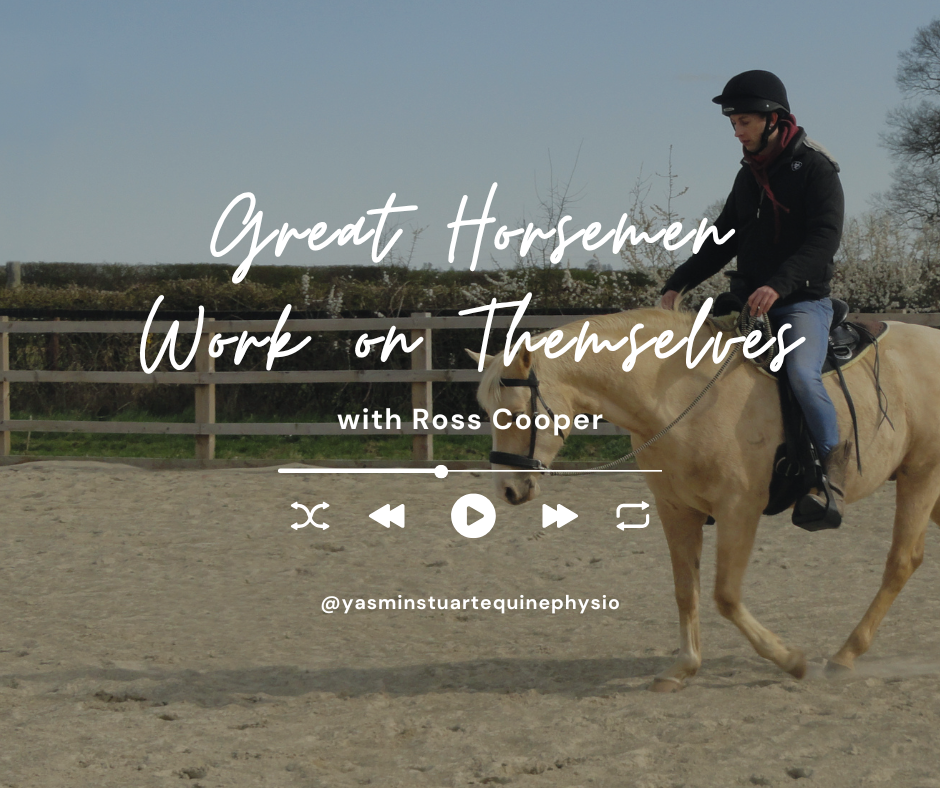
In addition, Ross is an International Horse Agility Accredited Trainer (HAAT), a British Working Equitation Approved Instructor, regular contributor to a number of leading equestrian publications and co-host of The Little Horse Big Conversation Podcast.
Based in the Midlands, United Kingdom, Ross has worked internationally in the United States, Central America and Southern Africa, regularly travelling Nationwide for private lessons, clinics, demonstrations and educational talks.
Details of his work can be found online at www.rosscooperofficial.co.uk
Here are some take home points from this conversation for you to reflect on:
1) How you show up to your training matters more than the discipline you work in.
Good horsemanship is not defined by the discipline, but by how thoughtfully, ethically and compassionately you work with the horse in front of you.
2) The horse’s lived experience is the centre point of any training methodology.
Your horse is an individual. Not a being to be controlled, “fixed” or managed into human ideology.
3) Exploration of new ideas is healthy
New ideas should be applied with care for the horse’s lived experience, and not a one-size fits all approach.
Be mindful that you can have excellent theoretical knowledge, but you need to recognise your emotional state as well as your horse’s emotional state, and evaluate the relevance of a technique in any particular moment.
4) Much of what happens between horses and humans is shaped by our interpersonal skills
This is based on our communication history with family and peers, social conditioning, trauma and unmet needs.
The more awareness we have of ourselves, the better decisions we can make for our horses.
5) Objectivity matters, but subjectivity is part of the human condition
Good practice is about balancing evidence basis with lived experience, treating the horse and human as an individual.
Turning ideas over, questioning our assumptions and recognising our blind spots can soften our own judgement, helping us to empathise with others - even if we don’t agree with their actions.
6) Intuition is as valuable as evidence basis
Intuition can be recognised as the quiet/direct voice in your head that is not accompanied by internal query or chitter chatter.
Oftentimes, things don’t go as well when intuition is dismissed in favour of more cerebral or externally motivated actions.
Evidence can support pattern recognition, whilst intuition and observation help us to respond to the horse in the present moment.
7) Not all problems can be neatly explained or immediately identified
You may not have the language or observational skills to recognise what is wrong with your horse, but your instinct that something is wrong is extremely valid.
Professionals may not have the answer, but they should support you in finding the answer. Even if that looks like “I respect that you suspect your horse is not okay, I don’t know what the problem is but I will support you in finding the answer.”
8) Ego is a protective mechanism that, when left unchecked, can distort horsemanship and professional culture
Some systems, professionals, or groups may keep people dependent, small, or uncertain rather than helping them grow into confident, informed partners for their horses.
9) Conflict resolution is an essential life skill.
Disagreement can be productive. In fact, respectful challenge and open dialogue are often where the greatest learning happens.
Whether with horses, clients, peers, or ourselves, so much of good practice comes down to how we communicate, listen, regulate, and navigate discomfort.
If we cannot manage conflict, defensiveness, or discomfort within our human relationships, it becomes much harder to navigate challenge clearly and compassionately with another species.
Responsibility includes asking how we were complicit in a situation - rather than focusing only on who was right or wrong, growth comes from asking: how did I contribute to this, and what can I do differently next time?
10) Great horsemanship begins with inner work - Good horsemen work on their horse. Great horsemen work on themselves.
Want to take a deeper dive into introspection?
You might enjoy these two videos: